Translate

Sunday, June 14, 2015

Technology Choices

Have you wonder what platform to use about technology? Google? Microsoft? Apple? Linux?
My district has chosen Goggle, however they have provided us with Lenovos that have Microsoft Office 365 as well. They have allowed us to get some training. Before, some teachers on special assignments were allow to use Apple laptops. 

As a teacher in the classroom learning to apply and integrate technology within my lessons, I will use whatever I can get access. So when the Internet is down, we can not use Goggle documents or presentations, so I have to use Microsoft PowerPoint, when my Pc is out of battery, I can use the Apple laptop.

I do have to say that Apples hardly break down. They are truly work horses! There is what you are paying for in an Apple.

As educators, we need to transcend the molds of a platform and move into teaching the students concepts and skills that can be apply in real life.

I have been teaching for a good chunk of time, and we need to connect to the real problems we are facing when educating our future students.

I believe that teaching students keyboarding skills, how to write a document in a word processor, how to create a graph, how to put a presentation together from the photos and video you took, the list goes on and on.

Does it really matter if you are doing these projects on a Apple, Microsoft, or Google? NO! It does not matter, there are just some adjustment in what the programs you are using, just like changing shoes? Right? Wearing boots has a different feeling than wearing your clogs, or tennis shoes.

Life is about concepts and skills you can live on, work on, dream on, struggle that makes life interesting!

So take that technology class your school district offers for free, and join in a education movement!

Thursday, January 1, 2015

Happy New Year!

Wishing everyone a magical, healthy, and educational New Year!

May all your wishes come true, and you are able to reach all of your goals this year!

Feliz Año Nuevo!

Les deseo un año lleno de salud, magia, y educación!

Que todos sus deseos se conviertan en realidad y obtengan todas sus metas este año nuevo!

Wednesday, November 12, 2014

I am a new teacher! What do I teach? I lost my way! Where do I start?

I have been asked " What do I teach? " this question seven times in the past 6 months. I thought I will write a guide to help out some of our brand new teachers out there and some of our veteran teachers who get burn out, (this is why we have vacations in the teaching profession).

Welcome to teaching! Welcome back to Teaching!
I'm excited to see new faces. New teachers are full of ideas, enthusiasm, and energy! These are great characteristics to have when you starting in teaching. Also, I see my colleagues in the Fall, they are all re-energized from vacations, and they can not wait to get their classroom set up!

Where do you start? Start wherever speaks to you. There is no order at all, ---I just lied---Classroom Management before all. Set your routines, schedules, and traditions for the year before anything else. Then pick a number and reflect below and start with any of them. I use numbers so it helps to know all the possible methods that may help you.

What is Classroom Management?
Classroom management is what the students have to do to be in your classroom. It is also your ability to talk to the students in order to set an order for you to be heard and understood anywhere you are with your group of students---anywhere in the school---in a field trip---anywhere! It is respect. It is an schedule. It is an understanding of what the day will be like in your classroom. Boring? Fun? Scary? Exciting? Puzzling?

If you do not get excited about passing on your wisdom, sharing what you have learned with patience, and your shortcuts of how to learn, or do a project, I will respectfully ask you to leave this profession. It is not for you. I have seen colleagues who yelled every day in their classroom----hint---if you are yelling---you do not have classroom management under control. It is sad! I feel sorry for those students! Can you imagine if your own kids were sitting in a classroom with a teacher like that? I do try to guide my adult colleagues to go find what their passion is, because it is not for teaching!  Well, there are all kinds of students in the world, some fast, some very very slow to get it, and everyone else somewhere in between.

Do you remember your favorite teacher? Why did you like/unlike her class? What did she/he make you do every day? Did you like it? or hate it? Please do not set a classroom to take revenge on all those bad teachers you had at school. What do you want your students to remember you by? What would be your contribution to their education? Be positive, enthusiastic, and creative!

Classroom management are set routines you do everyday to maintain an order so you can deliver your lessons. No order, no lessons! For example: Every morning by the first bell, my students know that they have to line up with their backpacks, before they come in we shake hands and they have to reply to me whatever welcome I give them. Usually it is "Good Morning". Any substitute teacher that I have, knows to shake and salute before the kids come in. This is a set routine to enter the classroom.
Then, my students walk over, hang their backpack, hang their coats or sweaters in a hanger, and come to sit down for me to speak about today---while we are waiting, kids have the freedom to talk to each other about whatever, the rain, their troubles, their siblings, etc. I get my laptop going, drink some tea!
I have a teaching wall. I have the most important activities that they have to know in front of them. It is made out of five pocket charts of different sizes. I am a Bilingual Spanish Kindergarten. So I adjust what I have in this wall. First things first. I set up who is going to be the Teacher of the Day. So every student takes a turn to be the teacher for a day. When is their turn--they (copy me), and delivers the Teaching Wall to the classmates with songs, chants, readings, counting,  every day. Every day.

I teach 180 days in a school year. Look at your contract and find out how many days you teach.

0. Before you can think about what to teach, you must have Classroom Management. If you can not control the students at any given point during the day (inside, outside, in the cafeteria, in recess, in an assembly, in a field trip), you will never be able to deliver all those clever, beautiful, funny, lessons you spent so much time putting together. No student, nor parent is going to appreciate any of your efforts at all! Trust me!

1. Look at the standards for your grade (whether you are using the State Standards or now the new Common Core Standards), which it would give you an idea of the skills the students need to have by the end of the school year. You are responsible for teaching those skills and writing in the report card whether the kids are learning them or not. The magic starts when you figured out how are you going to deliver those lessons for the students to learn.

2. Look at the report card for your grade. If the standards are not a high priority in your School District, then look at the report card (usually, they are aligned to your standards--usually!). Report cards usually have all the skills in all the subjects that students must learn, and it is a legal document for students getting services if they have any learning challenges during the school year. Some district have very strict policies about retention---others leave it to the teacher to decide if it would benefit the student at all. Please remember that just because a student does not speak English-----it does not mean----he does not understand you. Do not retained a student just because he has broken English. Does he understand the concepts? the big ideas? the process to do it? Does he have sense when he writes it?

3. Afterwards, you were most likely given some type of curriculum for Language Arts, Mathematics, Science, English as a Second Language, and Social Studies. If there is no curriculum that the District has adopted for any given subject--Do not panic! You can use the standards or report card as a guide. For example, I know that in Social studies and Science they give you an overall theme for your grade. Like American government which is 5th grade, the Roman Empire is for Sixth grade, Animals starts in second grade,Addition and subtraction starts in kindergarten, etc.

4. How are you going to put it all together? Well, this start with you. You need to look at what make you arrive to teaching? Why do you want it to be a teacher? Was is something you always want it to do? Were you told by friends and family of how good of a communicator you are? Take a look at yourself and answer the following questions to get you going:  Are you a talker? Are you a visual person? How do you learn a new skill? Do you like to play games? Do you use memorization skills like flash cards? Teaching is a reflection of how good of a student you are. So in other words, you will be mirroring your own study skills.

Yes, you will have to break it down, make it fun and interesting, a lot of scaffolding, and tons of vocabulary with definitions. Vocabulary to teach ANY subject is KEY! (This is all about how creative you can get, what kind of materials you have develop? Have you heard of Teachers pay teachers? or Teachers Notebook? These are websites of teachers who have written their own curriculum and their own activities because the Published given Curriculum lacks so much. I write my own. I want to control how to deliver the lesson so that the students get it from the start based on what they have to know for their grade.

5. Another tip for you is to see the big picture. In the adopted curriculum suggest you how to deliver those lessons, whole group? small groups? Hands-on projects? worksheets? books to make?
This is where two bigger skills that you must have come into play: Classroom Management, and Organization.  Yes! It is a cycle----a cycle of inquiry. It starts all over again!

Does this make sense to you? I hope this helps you. This is a guide---just a guide---there are many other thousand ways to go about organizing, gathering, and more importantly Reflecting what kind of teacher you want to grow up to be.
Teaching is a combination of common sense, reflection, pondering, observations, and performance. Some call it an Art, others called a Science. I just simply call it "Teaching".

Share your experience and your own tips, what do you teach? where do you start? I will love to hear your experience. Leave me a comment!

Sunday, October 26, 2014

Number Jewelry!

After doing all the letter bracelets, the students have gotten use to the process of the activity. When we started doing the letter bracelets you noticed that I place a circle in the middle---that is to tell the students how much glue to place on it. To fill in that circle. I still had some students drop a lot more glue that what I had instructed, but the students understood what to do. Also, I told them that if they had place a lot more glue on it, they will have to count to 1000. This was fun! Some of my students' eyes were precious! But I think, they are learning the relationship with the counting to 100 to wait for the glue to dry. So eventually they will know that counting to 1000 means they placed a lot of glue in their bracelets!

After we have been making all those letter bracelets in Spanish and in English, now we are making number bracelets. One of the Common Core Standards is to compose and decompose a number. Also, we need to learn to represent that number in different ways. We use rekenreks, and now the Bracelet Literacy is taking over my classroom.

We are starting to make number bracelets by sorting and matching all the different number representations in one bracelet. After all the practice, my students are really able to do it independently. So I am placing this as a Math Center in my classroom.

Check out the Math Bracelets, by the way they are bilingual!

http://www.teacherspayteachers.com/Product/Number-Bracelets-1518233

Thank you for stopping by!


Friday, October 24, 2014

Children's creativity

It is amazing the creativity of the children! I think you can guess what she is doing. She has a laptop in front of her and she is using a tablet. If I only had enough to invest in having one for each of my kindergarten kids. Pretend play is the most fun to observe! 

Monday, October 20, 2014

Mathematics Number Literacy

Mathematics is such a great subject!

The young Kinder students are so open and they will enjoy and learn the attitudes of the adults around them. So, if you feared Math, guess what? Your children will fear it too!

It is all about how you present it and play with it. Yes! I do admit it, I do play, and yes I enjoy playing, it is so much fun! No wonder those kids are so addictive to "playing video games" they do it because it is fun and under the pretense of "playing" children get challenges in front of them and many times they do it without much thought. This is where having young kids addictive to playing video games can get serious. Young children do not have the capacity of decision making like an adult would have. Even teenagers lack it. This will be another post to talk about: when the brain develops decision making in teenagers.

Back to Math, I have been working with a friend who happens to be a Bilingual Mandarin Teacher. I have learned so much, and I want it to include at least the numbers in this Math center, my students are very much enjoying it.

One of the ways in which I have been teaching math is by exposing my students to all different ways we can count--you know, numeric representations: tally marks, number lines, ten frames, dominoes, dice, rekenreks, etc. This build up automaticity and subitizing of the numbers. So that mental math becomes easier and basic operations of addition, subtraction, division, and multiplication become faster so that you do not have to take 10 minutes checking the change you got from the store cashier and you hold up the line.

Math is everywhere!

So one of the activities I do is that I give each student its own copy, so they can create their Chiqui*book. They write their name below the number, we cut it, and staple it on the left corner. I did not want to add page numbers because I want each child to order it their own way.
For the regular Spanish and English Language art Chiqui*books I do place number pages for the sake of reading, but this is more free---if you will.
One of the centers that I create is that I make about 7-8 copies in different cardboard and laminate it. So then, I choose all the ten frames of each number and create a center, I do this with each page of the book. So that there are all those cards in each center. I add the subtraction and addition cards so that students can create their own number sentences. I also add in other centers the Venn diagram that we can of created it as a group----since I have not yet introduced shapes in a formal way--the Venn diagram will go through some metamorphosis later. Right now, it is simple and to the point.

One of the games I play with the students is that I set different numbers of strings, so that the students learn to practice counting from that number like 3-9. So the first number is 3---not a 1 or a 0. Another set is 8 to 14, another one is 13-19, so that when the students hold the card up they have to figure out that the first number is an 8 or a 13.

I had to do this activity for a whole week before they started to understand that there was not a number 1 to start the string of numbers. Now, with all the practice they are starting to get it. I will not claim any victory until May. When we have done it over a zillion times. Practice make automaticity and comprehension happen at the same time.

Anyway, what games do you play? Share them here with us, so we can all learn and do them as centers or math activities.  I do like the fact that Common Core is bringing and validating that there are different ways to learn.  I really like it!

Have a great class day!


Thursday, October 2, 2014

Literacy jewelry : Interactive Bracelets!

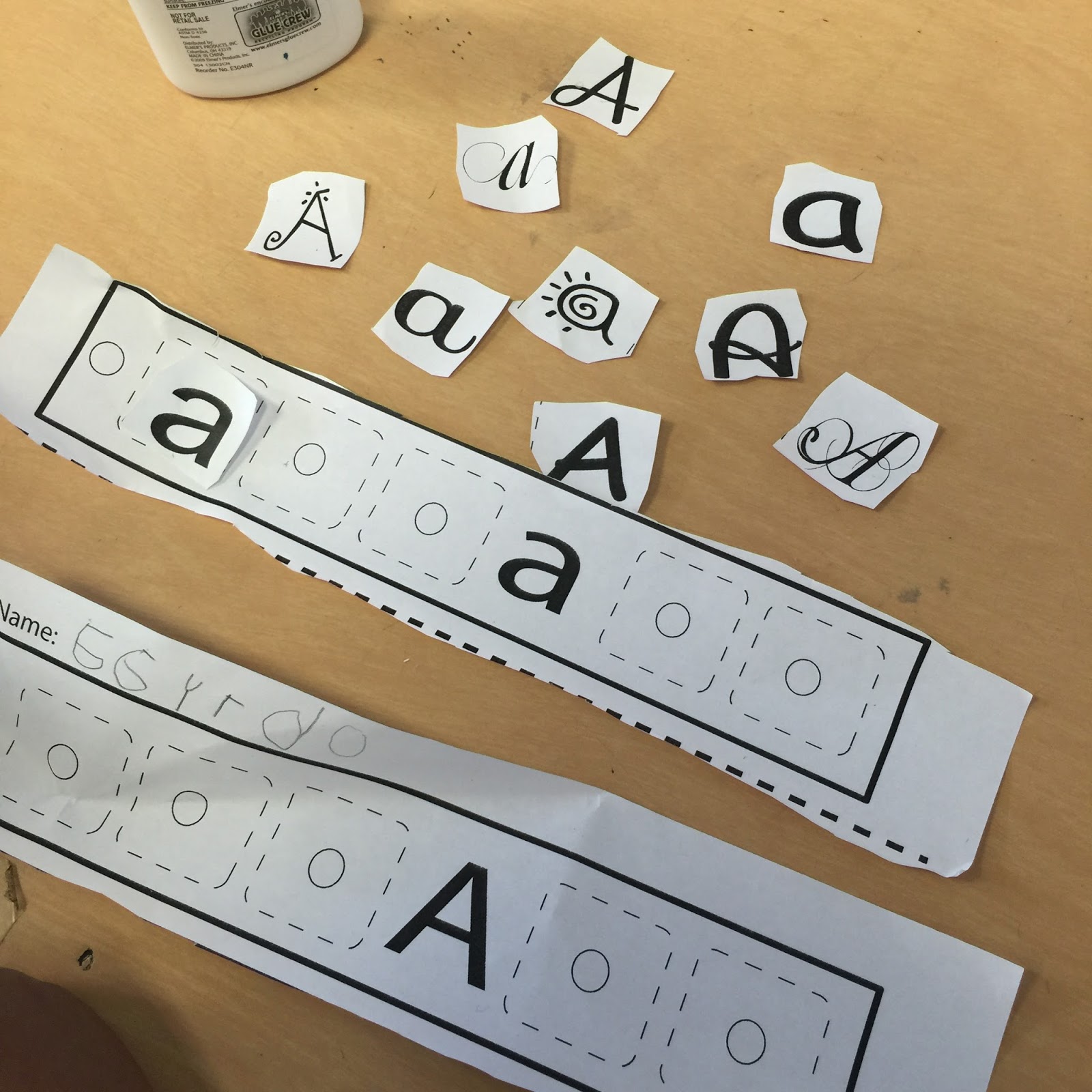
Every year we do all the foundational skills like: identification and recognition of upper case and lower case letters, classification of letter sounds, sorting of words by letters.  I am spicing it up by making interactive bracelets.
So it is the same activity that I have done in the past, but when they are done, they have bracelets to wear. When I started this activity, I allowed them to wear their bracelets when we went to lunch, and other students were asking them about the letters, even the Noon Supervisors and other teachers started asking my students questions. So, they are getting prompt by everyone which is something Kindergarteners love---- the attention!

I am starting it with two letters and 4 pictures for each, in alphabetic order and upper case letters.
They are turning out very nice, and the kids are really into it. One of the moms came and ask me to send home an extra one because their little sister also wanted her own letter bracelets! How fun!


The benefits:
  1. We are learning new words that start with the letters we are doing
  2. We practice writing out our name 3 times
  3. We are learning to color inside the lines and making it beautiful--they get better compliments!
  4. We are learning to classify the letters by choosing (the upper or lower case letters) or (beginning sounds) to glue it on.
  5. We are practicing cutting carefully!
  6. We are learning to control how much glue we use (always a PLUS in Kindergarten!)
  7. We are learning spatial spacing by bending the paper and creating the bracelets ( A mathematical concept when we do tridimensional shapes)
  8. We are learning to count by holding down the bracelet and letting the glue dry ( A must to get them to count to 100 by the end of Kindergarten--Common Core Standard!)
  9. Once we are done we can recall the pictures and identify the letter it starts with.
  10. The kids love the attention they are getting by wearing the bracelets during school recesses and lunch.
Not bad for Paper Jewelry ---Fun Literacy!

My students now look forward to making bracelets. I was worry that the boys were not going to be into it.  I decided to introduce the whole concept as a Superpower---Super Letter Power! They all got into it. Some boys compare it to the web action like Spider man does, and they press each picture around their bracelet as if a new hidden weapon materializes to attack their nemesis! Very creative imaginations!

We finish with the Upper case, now I am introducing them to the lower case letters. Also is no longer in the alphabetical order, now we are mixing it up. By the way we are doing the Spanish bracelets in the Spanish order of letters, first with the vowels plus y, then the consonants.

During English Language Development we do our English Bracelets. So they end up with 4 bracelets some days.  They love it!

Check them out here:
http://www.teacherspayteachers.com/Product/Literacy-Jewels-Interactive-Bracelets-1478420